
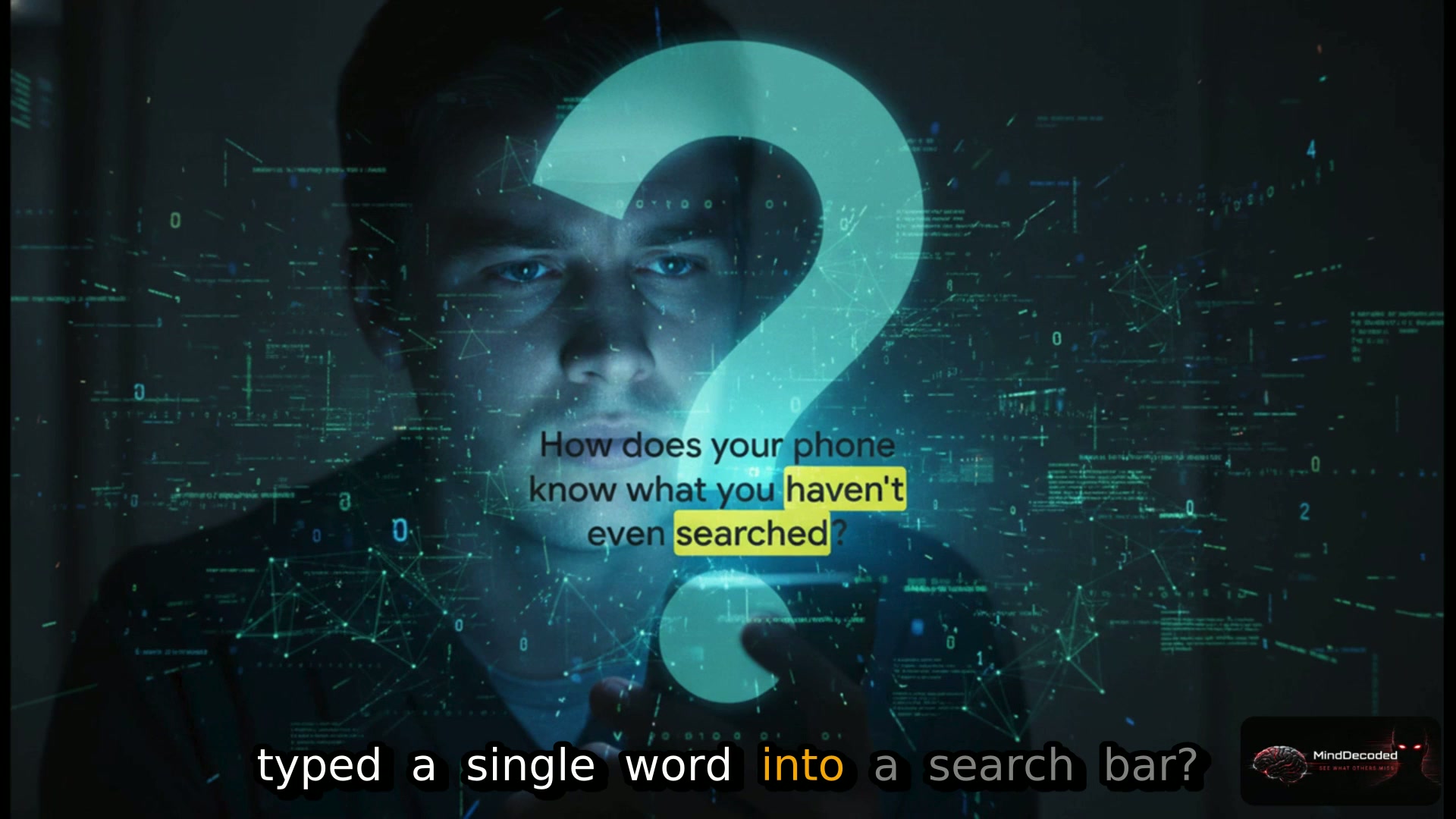
You think about buying running shoes. Minutes later, running-shoe ads appear. You discuss a holiday over dinner and your feed fills with hotels. It feels too exact to be chance. The natural conclusion is unsettling: your phone must be listening—or somehow reading your mind.
Sometimes an app may have microphone permission, and digital services do collect substantial amounts of data. But a relevant ad by itself does not show that a private conversation was recorded. Modern platforms often need something less dramatic: the trail of behaviour you already leave behind, combined with predictions about people who behave like you.
The real story is not telepathy. It is inference. Your device and the services you use can observe actions, connect context and estimate what you may do next. When the estimate lands, it feels magical. When it fails, you usually scroll past and forget it.
Your phone can seem to read your mind because apps and websites collect behavioural signals—clicks, watch time, searches, purchases, location and interactions—and recommendation systems use them to predict interests. Shared context, advertising networks and confirmation bias make successful predictions feel even more personal. This is pattern recognition, not literal mind-reading.
You reveal more through behaviour than through words
Most people imagine a digital profile as a list of things they explicitly typed: age, location, interests. Behavioural data is richer. A platform can record which video you paused on, how long you watched, what you skipped, which account you followed, what time you return and which notification brought you back.
None of these signals has to be decisive. A single pause may mean nothing. Thousands of small actions create a pattern. Google’s own explanation of personalised advertising says account activity, interactions with sites or apps, searches, videos and location-related information can affect which ads appear, depending on settings. The important point is that silence is still data: not clicking, abandoning a page and repeatedly viewing a category can all help estimate preference.
Websites also use cookies and similar storage or access technologies. The UK Information Commissioner’s Office identifies cookies, tracking pixels and device fingerprinting among technologies that can recognise devices or track browsing behaviour. When trackers operate across many pages or apps, an isolated action can join a wider profile.
Then there is context. Your approximate location, time of day, device type and the content currently on screen can influence an ad even without a persistent personal dossier. If you and a friend spend time in the same places, use the same Wi-Fi, follow similar accounts or shop for related products, separate data trails can still lead to similar predictions.
The algorithm does not need certainty—only probability
A recommendation system does not form a human-style understanding of you. It ranks possible items according to estimated usefulness, relevance or engagement. Some systems compare your actions with content features. Others find patterns among users with similar behaviour. Many combine multiple approaches.
Imagine that people who watched three home-renovation clips, searched for mortgage rates and visited a furniture site often engage with kitchen advertisements next. If your recent behaviour resembles that sequence, the system can place a kitchen ad in front of you before you consciously formulate “I might remodel the kitchen.” It predicted a statistical next step, not a private thought.
Prediction can also expose attributes a user never declared. Research has shown that recommender systems can infer demographic information from ratings alone. Data brokers and marketing analytics firms have long offered products designed to estimate consumer interests and likely behaviour. The prediction may be wrong at the individual level while still being profitable across millions of impressions.
Scale changes the experience. A platform can test enormous numbers of recommendations. You notice the one that arrives at exactly the right moment, not the hundreds that were irrelevant. Even modest predictive accuracy can produce uncanny hits when the number of opportunities is large.
Why the coincidence feels more accurate than it is
You remember the hit and forget the misses
An irrelevant ad produces almost no memory. A relevant one creates surprise, so it becomes evidence in your personal story about being watched. This is a form of selective attention: successes receive emotional weight while failures vanish into the feed.
Attention makes a topic suddenly visible
After thinking about a red car, you notice red cars everywhere. The number may not have changed; your attention has. The same can happen online. A topic becomes mentally salient, and content that was previously background noise now feels newly targeted.
Other people can create the signal
Your partner searches for flights. A retailer connects purchases to a household address. A friend sends you a product link. You visit the same location as people interested in an event. You may not know which signal entered the system, so the resulting recommendation appears to have started inside your head.
Broad predictions can feel intimate
Life stages are surprisingly predictable. Moving home, changing jobs, becoming a parent or starting a fitness routine generates clusters of purchases and searches. An ad designed for a broad group can feel personally selected when you happen to be entering that group.
So—is your phone secretly listening?
The honest answer is narrower than either extreme. A relevant ad is not evidence of microphone surveillance. Phones do contain microphones, apps can request access, voice assistants process audio when activated, and malicious or poorly governed software exists. But behavioural prediction offers a powerful explanation that does not require continuous covert recording.
Continuous audio collection at scale would also create technical, legal and reputational risks. That does not mean you should trust every app. It means the right response is verification rather than panic. Check which apps have microphone permission, whether they recently accessed it and whether access makes sense for their function.
On recent Android versions, the Privacy Dashboard shows which apps used permissions such as microphone, camera and location, and when. On iPhone, Privacy & Security settings let you review permissions, while App Tracking Transparency controls whether apps may track activity across other companies’ apps and websites. Platform controls are not a guarantee of perfect privacy, but they replace guessing with evidence.
The uncomfortable truth is not that your phone knows your thoughts. It is that your observable behaviour may predict your next thought surprisingly well.
Prediction can shape behaviour as well as anticipate it
A recommendation is not merely a mirror. It changes what you see next. That exposure can affect what feels normal, urgent or popular. If an algorithm predicts that you will engage with anxious content and then supplies more of it, the prediction helps create the environment in which future engagement occurs.
This does not erase personal agency. It does mean that digital choice takes place inside an edited field of options. You cannot click what was never shown. The order, repetition and emotional framing of content influence attention before deliberate evaluation begins.
Researchers studying recommender systems increasingly consider long-term behaviour, not only a single click. Google Research has described models using immediate behavioural signals to predict future platform visits. The commercial details vary, but the principle is clear: today’s interaction can become training data for tomorrow’s feed.

How to take back meaningful control
1. Audit permissions by function
A weather app may need approximate location; a torch app probably does not need your microphone or contacts. Remove permissions that do not match the service. Choose “only while using the app” or approximate location when that is sufficient.
2. Review cross-app and advertising settings
On iPhone, review Settings → Privacy & Security → Tracking. In Google’s My Ad Center, you can turn personalised ads off and control whether certain account activity is used for ads. Remember that disabling ad personalisation does not eliminate every form of data processing or recommendation.
3. Reduce the data you no longer need
Delete unused apps and old accounts. Review saved search, location and viewing histories. Shorten automatic retention periods when services offer that option. Fewer stored signals mean fewer old contexts available for future inference.
4. Strengthen your browser
Use built-in tracking protection, block unnecessary third-party cookies where available and reject non-essential cookies when you do not want them. Private browsing limits what remains on your device after a session, but it does not make you invisible to websites, networks or logged-in services.
5. Separate identities when useful
Do not automatically use one social login for every service. Separate work and personal browser profiles, and avoid remaining signed in everywhere. Separation will not eliminate profiling, but it can make effortless linking harder.
6. Interrupt the recommendation loop
Clear or pause histories, use “not interested” controls, unfollow sources that produce compulsive reactions and deliberately search outside your usual topics. Diversity of input makes the feed less able to define the boundaries of your attention.
7. Treat urgency as a reason to stop
Personalised ads often work because relevance meets emotion at the right moment. When an ad feels uncannily specific, do not reward the feeling with an immediate purchase. Wait, compare independently and decide when the emotional charge has faded.
Your phone is a prediction machine, not an oracle
The difference matters. “It reads my mind” creates helplessness. “It predicts from signals” reveals points of control. You can restrict permissions, reduce histories, change settings, diversify inputs and decide not to act on a perfectly timed prompt.
No privacy setting creates invisibility, and no single explanation covers every platform. But you do not need perfect secrecy to gain meaningful autonomy. You need a more accurate model of the system: behaviour becomes data, data supports inference, inference selects exposure, and exposure can influence the next behaviour.
Once you see that loop, the uncanny ad loses some of its magic. The most important question is no longer “How did it know?” It becomes “What signals did I give, what choices were placed in front of me, and what do I want to do next?”
Watch the original video
See the MindDecoded visual explanation of behavioural tracking, predictive algorithms and the feedback loop that can make your phone feel almost telepathic.
Watch on YouTube ▶Frequently asked questions
Is my phone listening to my conversations for ads?
A strangely relevant ad is not proof that your microphone was used. Behavioural data, searches, location, shared networks, purchases and statistical prediction can explain many apparent coincidences. Review microphone permissions and access history if you are concerned.
How can an app know what I want before I search?
Recommendation systems learn from signals such as viewing time, clicks, follows, location and patterns shared with similar users. They predict probabilities, not thoughts, and incorrect predictions usually pass unnoticed.
Does turning off personalised ads stop all tracking?
No. It can reduce the use of certain data for advertising, but services may still process data for security, measurement, functionality, legal obligations or contextual recommendations. Settings differ by platform.
What privacy settings should I check first?
Audit microphone, camera, location and contact permissions; review cross-app tracking settings; turn off ad personalisation where desired; delete unnecessary activity histories; remove unused apps; and use browser tracking protection.
Sources and practical controls
- UK ICO guidance on cookies, pixels, fingerprinting and online tracking
- US FTC report on data brokers and predictive marketing analytics
- Google Research on behavioural signals in recommender systems
- Android Privacy Dashboard and permission controls
- Apple guidance for app tracking permissions
- Google My Ad Center controls
Note: This article provides general education, not a forensic assessment of any app or platform. Privacy controls and product behaviour change over time; review the current settings and policies of the services you use.