
You open your phone for a minute. A headline appears twice. A creator repeats the same claim. Three comments agree. Later, when someone asks what you think, the answer seems to arrive from inside you. But part of it may have been assembled by what your attention encountered.
Information does more than add facts to an untouched mind. It affects which possibilities are visible, which emotions accompany them and which explanations feel familiar. Long before you consciously form an opinion, the information environment has helped define the menu.
This is not proof that everyone is controlled by a single hidden actor. Influence is distributed. Editors, advertisers, friends, creators, algorithms and our own habits all select what reaches us. The result is less like remote control and more like invisible architecture: we still move, but some paths are brighter, wider and repeated more often than others.
Information can influence the mind through five connected mechanisms: repetition makes claims familiar; emotional framing changes what feels important; social proof turns apparent consensus into a shortcut; algorithms personalise exposure; and identity makes some messages feel like loyalty tests rather than factual questions.
Information does not simply enter perception—it helps build it
Attention is selective. At any moment, more signals compete for processing than the mind can examine. What receives attention becomes easier to recall; what is easier to recall can feel more common, urgent or representative. A dramatic story may dominate judgment even when it is statistically rare. A quiet base rate can disappear because it lacks emotional imagery.
Selection is unavoidable. No news feed, classroom, friendship or individual memory can contain everything. The problem begins when selection is mistaken for a complete map of reality. If every visible example points in one direction, we may conclude that no alternative exists—even when the environment filtered it out.
A healthy information practice therefore asks two questions: “Is this claim supported?” and “Why is this the claim I am seeing now?” The first evaluates content. The second examines the system that delivered it.

Five ways information changes your mind without announcing itself
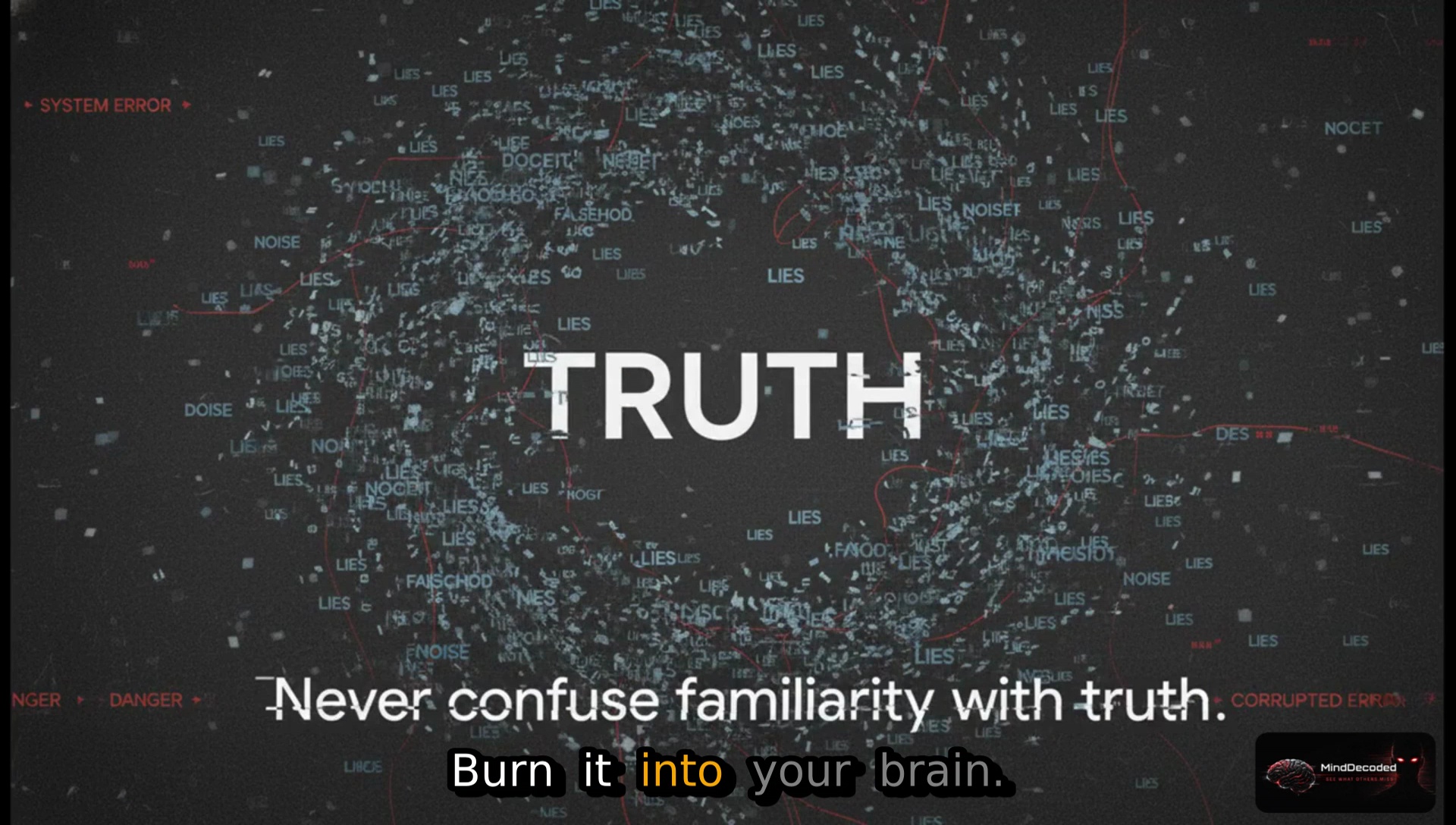
1. Repetition turns familiarity into a feeling of truth
A repeated statement becomes easier to process. That fluency can be misread as evidence: the claim feels less strange, so it begins to feel more plausible. Psychologists call this the illusory truth effect. Research has found it across trivia, headlines, opinions and marketing claims, affecting both true and false material.
Repetition does not hypnotise everyone, and implausible claims can still be rejected. But online repetition is especially deceptive because the same message may appear to come from several independent voices. One rumour is copied by multiple accounts, screenshotted, paraphrased and returned by a recommendation system. Volume begins to resemble verification.
Use a simple correction: never treat recognition as a source. When a claim feels familiar, ask where you first encountered it and whether the sources are genuinely independent. Familiarity answers “Have I seen this?” It cannot answer “Is this true?”
2. Emotional framing decides what the facts seem to mean
The same outcome can be described as a survival rate or a mortality rate, money saved or money not lost, security or surveillance. The factual quantity may remain identical while the frame changes attention, emotion and preference.
Frames are not automatically dishonest. Clear communication always chooses language. Manipulation appears when emotionally loaded framing hides material facts, exaggerates one interpretation or prevents a balanced comparison. Fear frames compress time. Outrage frames assign moral urgency. Hope frames can make uncertain benefits feel imminent.
Translate the frame. Convert percentages into natural frequencies. Ask how the same information would sound in neutral or opposite language. If “90% success” feels compelling, also consider “10% failure.” The goal is not cynicism; it is seeing whether your judgment survives a change in wording.
3. Social proof transforms visibility into apparent consensus
Other people are valuable sources of information. If many independent observers agree, that may deserve attention. Yet likes, shares and comments measure visible engagement, not necessarily knowledge or truth. A small active group can dominate a quiet majority. Bots, coordinated networks and selective moderation can distort the signal further.
Social proof also influences what feels safe to say. When one position appears overwhelmingly popular, disagreement carries an imagined social cost. People may remain silent, making the consensus appear even stronger. The displayed crowd becomes partly self-reinforcing.
Separate evidence from applause. Ask whether the people endorsing the claim possess relevant expertise, whether they reached it independently and whether contrary evidence is allowed to remain visible. Popularity can tell you what travelled furthest. It cannot substitute for the route by which a conclusion was reached.
4. Algorithms shape the information available for thought
Recommendation systems learn from behaviour: what you pause on, watch, search, like or ignore. Their objective is often engagement or predicted relevance, not a complete and balanced education. The more successfully a system anticipates attention, the more personalised your visible world becomes.
This matters because beliefs are formed from available evidence. If one type of story is repeatedly presented, it becomes cognitively accessible. But the popular claim that algorithms simply “brainwash” users is too strong. Research suggests a more complicated interaction among platform design, user choice, social networks and prior preferences. In experiments, slanted recommendations changed what people selected without necessarily producing large short-term changes in political attitudes.
The accurate conclusion is still important: algorithms influence exposure. They decide which door appears next. They do not fully determine whether you walk through it, but repeatedly arranging the corridor can change the journey.
5. Identity converts information into belonging
The most resistant beliefs are often connected to who we are: our community, morality, profession, nationality or political group. When a claim signals identity, evaluating it can feel less like checking a fact and more like deciding whether to betray the people who accept us.
Identity-consistent information receives a warmer welcome. Contradictory information can trigger defensive scrutiny: we demand perfect evidence from an opposing claim while accepting a friendly one after a glance. This asymmetry is not limited to any ideology. It is a human vulnerability.
Notice the moment a factual question becomes “What would someone like me believe?” Replace it with “What evidence would change my mind?” If the honest answer is “nothing,” the belief is currently functioning as identity protection rather than an evidence-based conclusion.
Your information environment does not need to dictate your answer. It only needs to decide which questions, examples and emotions reach you first.
The feedback loop: how your feed learns to repeat you
Personalisation begins with a real preference. You watch one dramatic video longer than a neutral one. The system recommends a similar clip. You engage again, and the signal strengthens. Soon the feed looks like proof that the topic is everywhere, even though the apparent prevalence partly reflects your own earlier behaviour.
This loop can amplify interests, anxieties and existing beliefs. It can also be useful: relevant recommendations help people learn skills and find communities. The risk is forgetting that the feed is a prediction about your attention, not a survey of the world.
There is another subtle effect. Exposure can influence preference, and preference then guides future exposure. It becomes difficult to separate “I chose this because I like it” from “I like this because it was repeatedly available.” Both can be true.
Rather than trying to build a perfectly neutral feed—an impossible standard—create deliberate friction. Search outside recommendations. Follow high-quality sources that disagree with one another. Use chronological views where available. Periodically reset or diversify signals. Most importantly, do not confuse algorithmic confidence with epistemic confidence.
A practical system for protecting your thinking
Pause at the peak of emotion
High-arousal content invites immediate sharing. Treat anger, fear and triumph as a cue to wait. Emotion is information about your response, not proof about the claim. A short pause creates space for verification before your reaction helps spread the message.
Trace the claim to its earliest accessible source
A screenshot of a headline is not an article. A video describing a study is not the study. Follow citations, check dates and distinguish an original report from dozens of pages repeating it. If the evidence chain circles back to one unsupported post, apparent consensus collapses into duplication.
Use lateral reading
Do not remain on one page while deciding whether to trust it. Open independent sources and investigate the author, institution and claim. Professional fact-checkers often leave the original page quickly because context is found elsewhere.
Compare the strongest alternative
Do not compare your position with the weakest caricature of the opposition. Find the most serious counterargument and the best evidence supporting it. If your belief survives, it becomes better calibrated. If it changes, updating is not defeat; it is the purpose of reasoning.
Separate confidence from certainty
Use probabilities and conditions: “The evidence currently suggests…” or “I am confident, but I would revise if…” This language keeps beliefs responsive to new information. Certainty feels strong, but calibrated confidence is more intellectually resilient.
Design your own information diet
Choose a small set of reliable primary and analytical sources rather than consuming an endless stream. Include perspectives that use transparent evidence and correct errors. Limit sources that repeatedly provoke without informing. Attention is not just something you spend; it is training data for both the platform and your own mind.
Awareness is not immunity—but it creates a choice
Knowing these mechanisms does not place anyone outside them. Experts experience framing. Educated people absorb repeated misinformation. Critical thinkers still favour identity-compatible evidence. The danger of learning influence psychology is believing it only explains other people.
A better goal is intellectual humility with practical habits. Ask where a claim came from, what is missing, which emotion frames it, whether the crowd is independent and why the algorithm selected it for you. You will not eliminate influence. You will make the process more visible.
Your mind is shaped by information, but it is also capable of examining the shaping. That reflective step—the pause between exposure and acceptance—is where autonomy begins.
Watch the original video
See the five mechanisms illustrated in the MindDecoded visual breakdown of repetition, emotional framing, social proof, algorithms and identity.
Watch on YouTube ▶Frequently asked questions
How does information change your mind?
Information changes judgments by shaping familiarity, emotion, perceived social consensus, available examples and identity. These effects influence what feels true or important before deliberate reasoning begins.
Does repetition make people believe false information?
Repeated statements can feel more familiar and easier to process, which can increase perceived truth. This illusory truth effect can occur with both accurate and inaccurate claims, although repetition does not guarantee belief.
Do social media algorithms control what you think?
Algorithms influence which information becomes available and repeated, but they do not directly determine belief. User choices, social networks, prior attitudes and platform design all interact with recommendations.
How can I protect my mind from misinformation?
Pause before sharing, check the original source, compare independent evidence, separate emotional impact from factual support, diversify information inputs and revise beliefs when stronger evidence appears.
Sources and further reading
Important: This article is educational. Information influence is complex and does not prove that a platform, creator or individual controls a specific belief. Evaluate concrete evidence and behaviour rather than assuming hidden intent.