
Imagine being offered two options and choosing the one you prefer. Nothing seems coercive. But what if both options benefit the person presenting them—and the alternative they do not want you to consider has quietly disappeared?
This is how subtle manipulation often works. It does not seize control from you in one dramatic moment. It shapes the frame around your decision: what seems popular, what feels urgent, what appears morally acceptable and which comparison enters your mind first. You still choose, but the path has been engineered.
That does not mean every advertisement, request or disagreement is manipulation. Human beings influence one another constantly. Recommendations, negotiations and emotional appeals can be honest. The useful distinction is whether the influence respects your ability to understand the situation and say no—or tries to bypass it.
Subtle manipulation works by exploiting normal mental shortcuts. False choices narrow the field; social proof replaces evidence with popularity; urgency reduces reflection; guilt confuses care with obligation; anchoring distorts comparison; confusion exhausts resistance; and small requests create pressure to remain consistent.
Why psychological manipulation can feel completely normal
Your mind cannot investigate every decision from zero. It uses shortcuts. You look at what others are doing, compare a price with the first number you saw, remain consistent with earlier commitments and respond quickly when time appears scarce. These tendencies are not defects. They usually conserve attention and make social life possible.
A tactic becomes manipulative when someone deliberately arranges those shortcuts to benefit themselves while concealing relevant information, inventing pressure or making refusal emotionally expensive. The mechanism may feel ordinary because it is ordinary. The exploitation lies in the design and intent.
The Federal Trade Commission uses the term “dark patterns” for digital designs that trick or manipulate people into choices they might not otherwise make. Examples include false scarcity, misleading endorsements and interfaces that make one option prominent while hiding another. The same logic appears offline—in sales, relationships, workplaces and group conversations.
The seven tactics hiding in everyday decisions
1. The illusion of choice
“Do you want to do it now or after dinner?” sounds flexible, yet it removes the possibility of not doing it. “Would you prefer the standard plan or premium?” can hide the option to buy nothing. The tactic is not the existence of limited options; real life often has constraints. It is presenting a restricted menu as though it represents the whole decision.
A false choice keeps your attention inside the manipulator’s frame. You spend energy selecting between A and B instead of asking whether C, delay or refusal is available. To resist it, step outside the menu: “Before I choose between those, do I agree to this at all?” Restating the higher-level decision restores the missing branch.
2. Social proof that substitutes popularity for evidence
When a restaurant is crowded or a product has thousands of reviews, other people’s behaviour can be useful information. Under uncertainty, the group becomes a shortcut. But popularity does not prove quality, truth or suitability—and the signal itself can be staged.
Online, false activity messages such as “24 people are viewing this” and undisclosed endorsements manufacture a crowd. In a relationship or workplace, the phrase may be “Everyone agrees with me” or “Nobody else has a problem with this.” The goal is to make disagreement feel socially risky before you evaluate the claim.
Ask for the evidence beneath the crowd: Who exactly agrees? Were reviews incentivised? Is the majority relevant to my needs? A million people can describe what is popular. They cannot automatically decide what is right for you.
3. Manufactured urgency
Real deadlines exist. A flight leaves, a medical situation requires action and stock can genuinely run out. Manufactured urgency is different: the countdown resets, the “last chance” returns tomorrow or someone demands an immediate answer when waiting would change nothing.
Urgency narrows attention. The question shifts from “Is this a good decision?” to “Can I avoid losing it?” That emotional pivot favours reaction over evaluation. If the consequence of waiting is vague, ask for it explicitly. A legitimate deadline should survive a clear explanation. If someone punishes you merely for taking reasonable time, the pressure itself is evidence.
4. Guilt that turns kindness into debt
Healthy guilt can help us repair harm. Manipulative guilt assigns responsibility where it does not belong or makes love conditional on compliance: “After everything I have done for you,” “If you cared, you would,” or “You are making me feel this way.”
The critical question is not whether another person is disappointed. It is whether you actually violated a fair agreement or caused preventable harm. Someone’s discomfort with your boundary does not automatically make the boundary wrong. Try separating empathy from obligation: “I understand that you are upset, and my answer is still no.”
5. Anchoring: the first number controls the comparison
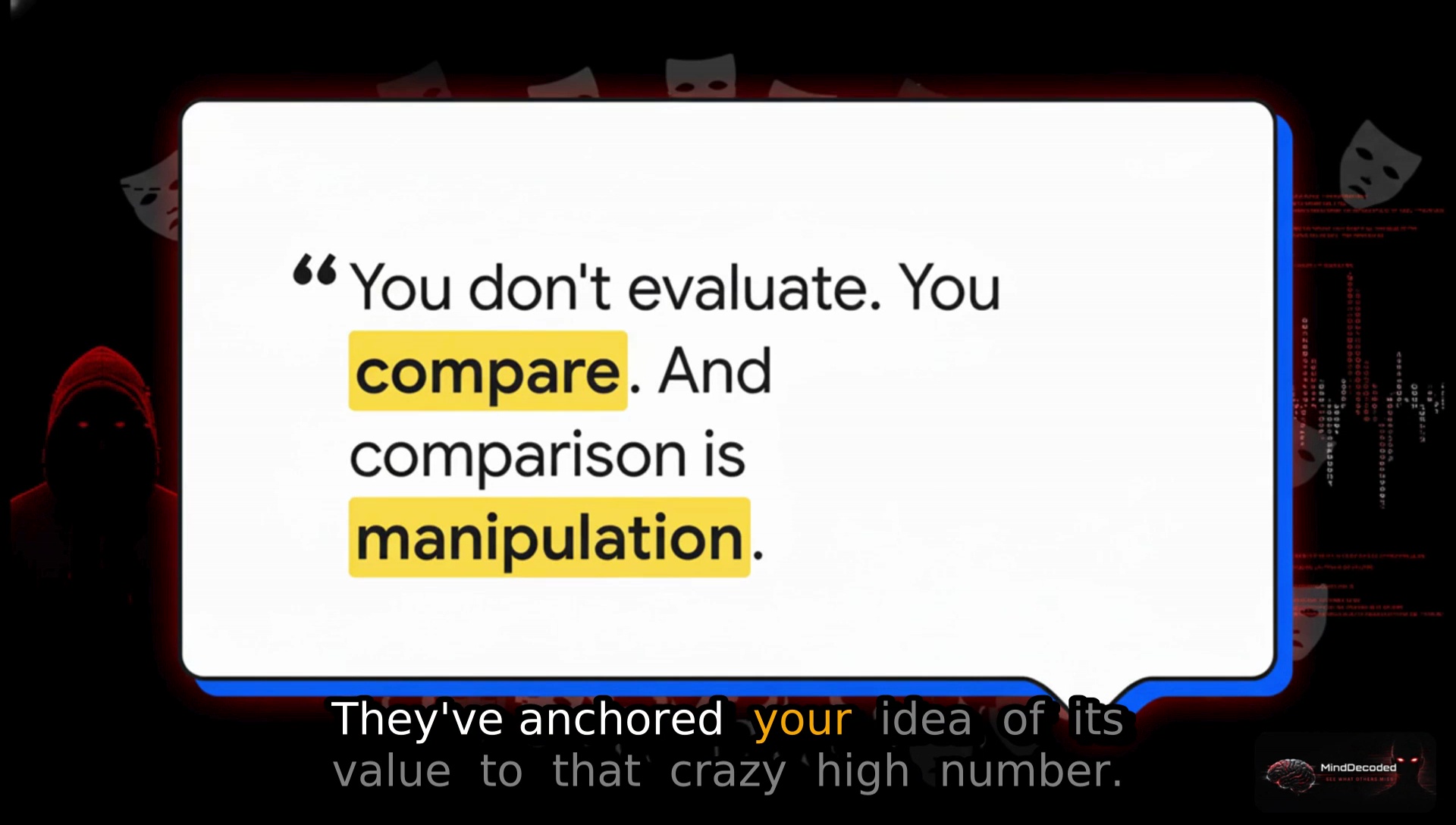
An anchor is the first prominent number, claim or reference point introduced into a decision. A £500 price crossed out beside a £199 offer can make £199 feel inexpensive even when the product is worth far less. An extreme opening demand can make the next demand appear reasonable by contrast.
The anchor works because we adjust away from an initial reference, often insufficiently. Its influence can persist even when the number is arbitrary. Defend yourself by creating an independent benchmark before negotiating or buying. Compare several real alternatives, calculate your budget and ask what you would consider fair if the first number had never appeared.
6. Confusion and information overload
Confusion can be accidental, especially in emotional conversations. It becomes a control tactic when explanations constantly change, simple questions receive long evasive answers, new accusations appear whenever one point is resolved or technical language hides the practical consequence.
The objective is not always to convince you of one false story. It may be to exhaust your ability to challenge any story. When you are mentally overloaded, accepting the other person’s conclusion can feel easier than tracing every contradiction.
Slow the exchange. Ask one question at a time. Request important terms in writing. Summarise: “The decision we are making is X, the cost is Y and the deadline is Z—is that correct?” If clarity repeatedly produces more chaos, postpone the decision and consult an independent person.
7. The small-request trap
A harmless request can become the first step in an escalating sequence: sign a petition, share your contact details, attend one meeting, lend a small amount, make one exception. After saying yes, people often feel pressure to behave consistently with that earlier choice.
Research on the foot-in-the-door technique shows that agreeing to a small initial request can increase compliance with a larger later request. This does not make every sequence sinister. The warning is escalation combined with concealment: the larger ask was predictable, but it was revealed only after your first commitment.
Every request deserves a fresh decision. “I agreed to the first part, not the next part” is logically complete. Consistency is useful when circumstances remain the same; it is not a contract to surrender future judgment.
Influence, persuasion or manipulation?
Influence is unavoidable. Persuasion offers reasons for a position. Manipulation interferes with the quality or freedom of the decision. The categories can overlap, so judge the process rather than relying only on tone.
Transparent persuasion identifies its interest, gives relevant facts, allows questions and leaves a realistic path to refusal. Manipulative influence hides its true objective, selectively withholds facts, invents constraints, punishes hesitation or exploits a known vulnerability. A charming request can be manipulative; a firm request can be honest.
Also consider pattern and power. A single clumsy guilt appeal is different from a relationship organised around guilt. A sales interface used once is different from a manager who controls income and repeatedly changes the rules. The greater the power imbalance, the more important genuine consent, clarity and time become.
The strongest defence is not suspicion of everyone. It is the ability to pause without surrendering your right to decide.
A practical defence: the CLEAR pause
You do not need to memorise every influence technique. Use a repeatable pause whenever a decision feels rushed, unusually emotional or confusing.
C — Clarify the real decision
State it in one sentence. Are you choosing between two plans, or deciding whether to buy anything? Are you resolving a problem, or proving your loyalty? Manipulation thrives inside a frame you never agreed to.
L — Locate the pressure
Name what is making the decision difficult: a deadline, fear of exclusion, guilt, a high opening number, silence or information overload. Naming pressure turns it from atmosphere into data.
E — Examine independent evidence
Check another source, price, person or written record. Ask what supports the claim besides repetition and popularity. For major financial, legal, medical or safety decisions, use qualified independent advice.
A — Allow time
Even a short delay can restore perspective. Say, “I do not decide this immediately,” or “Send it to me and I will respond tomorrow.” If a genuine emergency exists, the person should be able to explain the concrete consequence of delay.
R — Respond to the request, not the emotion
You can acknowledge feelings without accepting the demand. “I hear that you are disappointed. I am not agreeing to that.” Avoid defending every detail; excessive explanation creates more material to debate.
What to watch after you say no
A boundary is diagnostic. Ethical persuasion can tolerate refusal. The other person may disagree or feel disappointed, but they do not need to humiliate you, rewrite the request, recruit a crowd, threaten the relationship or keep you awake until you surrender.
If pressure escalates after a clear no, reduce exposure. Move important conversations to writing, keep records, involve a trusted person and avoid isolated confrontations when you feel unsafe. If coercive control, threats, stalking or violence are present, prioritise specialist support and a personalised safety plan.
The goal is not to become impossible to influence. That would also make cooperation and learning impossible. The goal is to recognise when influence stops respecting your mind. A decision is truly yours when you can understand the options, access relevant information and refuse without manufactured fear.
Watch the original video
See all seven tactics illustrated in the MindDecoded visual breakdown—and learn to notice the moment ordinary influence becomes control.
Watch on YouTube ▶Frequently asked questions
What are the most common manipulation tactics?
Common tactics include restricting choices, using social proof, manufacturing urgency, inducing inappropriate guilt, setting misleading anchors, creating confusion and escalating from a small request to a larger one.
How can I tell persuasion from manipulation?
Persuasion leaves room for informed refusal and presents relevant information honestly. Manipulation hides important intent, distorts information, exploits emotional pressure or makes saying no unusually costly.
Why do manipulation tactics feel normal?
They often use ordinary social shortcuts such as trust, consistency, reciprocity and attention to what others do. The same shortcuts can support cooperation, so the tactic becomes visible mainly through context, deception and repeated pressure.
What is the best way to resist psychological manipulation?
Slow the decision down, restate the real choice, ask for evidence, compare independent options, separate responsibility from guilt and treat any punishment for a reasonable no as important information.
Sources and further reading
Important: This article is educational. One behaviour does not establish malicious intent or a diagnosis. Focus on repeated patterns, honest context and whether your ability to make an informed, unpressured choice is being respected.