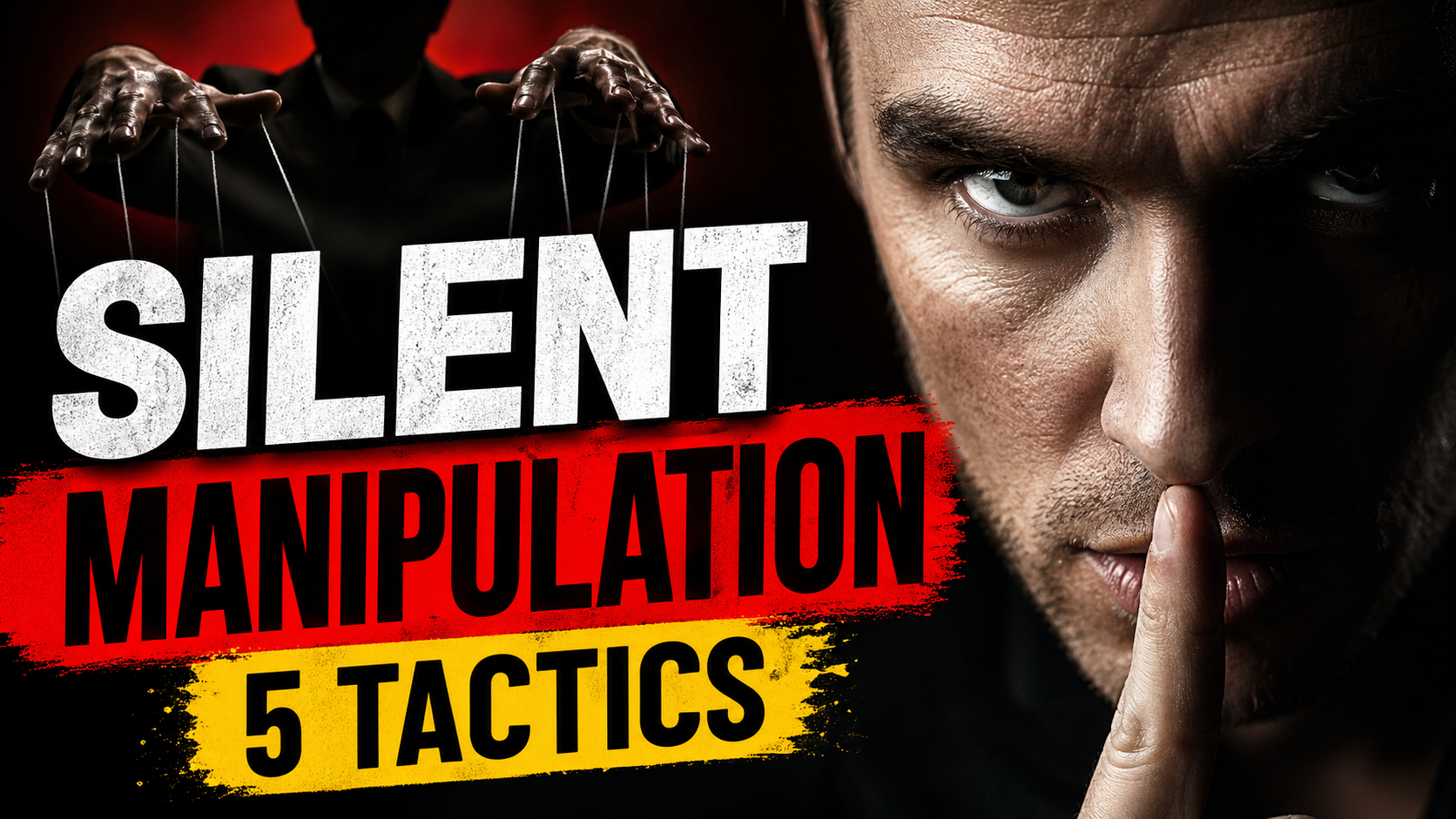
The most effective pressure does not always feel like pressure. It can feel like an awkward pause you rush to fill, a look that makes you abandon your point, or a silence that lasts until you surrender.
Overt manipulation gives you something visible to resist: a demand, a threat, a lie. Silent manipulation is harder to name because the behaviour is ambiguous. The other person can deny doing anything at all. Meanwhile, your nervous system registers rejection, tension or danger and urges you to restore the connection.
This is not an invitation to treat every quiet person, delayed reply or uncomfortable glance as malicious. Silence can be thoughtful, protective or necessary. People pause to regulate emotion, process information, avoid saying something cruel or simply because they communicate differently. The difference lies in the pattern: whether the behaviour repeatedly creates pressure, whether it is followed by direct repair, and whether your right to disagree remains intact.
Silent manipulation uses ambiguity as leverage. Withdrawal, staring, strategic pauses, controlling posture or delayed reactions can make you feel responsible for ending discomfort. A healthy pause is communicated and temporary; manipulative silence is used to punish, destabilise or obtain compliance without owning the demand.
What silent manipulation actually is
Communication is never only verbal. Gaze, distance, facial expression, posture, timing and responsiveness carry relational information: interest or indifference, warmth or hostility, equality or dominance. Research on nonverbal communication shows that people use these channels to interpret trust, composure and control. That makes them powerful—but not perfectly readable.
A cue is not proof. Folded arms may mean defensiveness, cold temperature or comfort. A pause may be strategic or simply thoughtful. Accurate interpretation requires clusters of behaviour, repeated situations and what happens after clarification. The goal is not to become a mind-reader. It is to notice when ambiguity consistently pushes you toward one outcome.
Covert control has a built-in advantage: plausible deniability. If you challenge the behaviour, the person can say, “I never asked you to do anything.” Technically, that may be true. But the relevant question is whether the silence, withdrawal or expression was repeatedly used until you changed your behaviour.
Five silent manipulation tactics people often miss
1. The punitive silent treatment
A regulated pause sounds like: “I am too upset to talk productively. I need an hour, and I will come back at seven.” Punitive silence offers no clear duration, no reassurance and no repair. Contact is withheld until you apologise, chase, abandon a boundary or accept the other person’s version of events.
A recent systematic review describes the silent treatment as a form of relational ostracism whose motives can range from emotional regulation and avoidance to manipulation and power management. Across the reviewed research, persistent use was associated with distress, reduced relationship satisfaction and weakened problem-solving. The nuance matters: not all withdrawal is abusive, but chronic silence used as punishment can be deeply destabilising.
The target often works harder than the person who withdrew. You review every sentence, send multiple messages and offer concessions just to make the relationship feel normal again. Relief arrives when contact resumes, which can train you to comply faster next time.
2. Eye contact used as dominance
Eye contact can communicate warmth, attention and confidence. In another context, an unbroken stare can signal: “Do not challenge me.” The power comes from social pressure. You look away, soften your statement or laugh nervously, and the other person never has to address your actual argument.
Research treats interpersonal dominance as something achieved through communication, including nonverbal behaviour. Yet eye contact is culturally variable and individual differences matter. The useful test is not “Did they stare?” It is “Did the look repeatedly appear when I disagreed, and did it function to shut down the conversation?”
You do not have to win a staring contest. Break eye contact naturally, slow your breathing and return to the content: “I have not finished my point.” Refusing the frame is more effective than copying the intimidation.
3. Strategic distance and exclusion
Someone becomes noticeably cold, leaves you out of shared plans or removes ordinary affection after you assert yourself. Nothing is explained. The uncertainty makes you search for the rule you broke—and often invent a concession to regain belonging.
Social exclusion threatens basic needs for belonging, self-esteem, control and meaningful existence. That is why even subtle exclusion can produce a powerful urge to reconnect. A manipulator can exploit that urge by making inclusion conditional on obedience.
Distinguish a boundary from a social penalty. A boundary explains what the person will do to stay safe or regulated. A penalty withdraws ordinary connection to make you reverse a legitimate choice. Directly ask: “Are you taking space, or are you ending contact until I agree?” The answer—and the willingness to answer—provides information.
4. Body language that occupies the room
Blocking a doorway, moving into your personal space, standing over you while you sit, turning the body away when you speak, exaggerated sighs and contemptuous expressions can all shift the power balance. Each gesture alone may be explainable. Together, timed around disagreement, they can create a clear message: your contribution is unwelcome.
Humans spontaneously coordinate posture, gesture, facial expression and rhythm during interaction. This synchrony often supports connection. A controlling person can instead disrupt it—refusing normal responsiveness or using physical positioning to make you adapt around them.
Name observable behaviour rather than claiming hidden intent: “Please step back.” “I will continue when we are both seated.” “When you roll your eyes while I speak, this does not feel like a constructive conversation.” Concrete language gives the other person an opportunity to correct the behaviour and reduces argument about motives.
5. The delayed reaction trap
You ask a reasonable question. They wait. The silence stretches just long enough for you to doubt yourself, add explanations and weaken the request. Or they delay affection, approval or a decision until you become anxious and accept worse terms.
Pauses are not inherently manipulative. Good negotiators, careful thinkers and emotionally regulated people pause. The tactic appears when delay is selectively used to manufacture uncertainty and make you negotiate against yourself.
Do not fill every silence. Let your statement stand. If a decision is needed, give a reasonable deadline: “You do not have to answer now. Please let me know by Thursday.” A defined frame turns an emotional vacuum into a practical process.
The hidden demand inside silent manipulation is often simple: end your discomfort by giving me the outcome I want.
Healthy pause or silent punishment? Use four tests
1. Is the pause communicated?
Healthy withdrawal provides basic orientation: “I need space,” “I am safe,” and “I will return.” Manipulative withdrawal leaves you guessing because the guessing is part of the pressure.
2. Is there a path back to dialogue?
A pause supports regulation when conversation resumes with some willingness to address the issue. Silence becomes corrosive when it replaces problem-solving indefinitely or ends only after submission.
3. Is the behaviour proportional?
Taking an evening after a painful argument may be understandable. Withholding affection for days because you disagreed about dinner is not proportional. Look at the size of the response relative to the trigger.
4. Can you keep your “no”?
The clearest test is whether disagreement remains safe. If silence, staring or distance disappears only when you comply, the behaviour is functioning as leverage—even if the person refuses that label.
How to respond without being pulled into the game
Regulate before you interpret
Ambiguity invites catastrophic stories. Before confronting anyone, slow the process. Feel your feet, release your jaw, write down what objectively happened and separate it from your interpretation. “They did not reply for six hours” is observable. “They are punishing me” is a hypothesis.
Ask once, clearly
Use language that leaves room for an innocent explanation while protecting you from an unhealthy pattern: “You have been quiet since our disagreement. Do you need time, or is there something you want to discuss?” Ask once. Repeated pursuit can reward withdrawal with attention and control.
Set a boundary around the process
You cannot force someone to speak, but you can decide what you will participate in:
- “I respect your need for space. I am available tomorrow, but I will not keep sending messages tonight.”
- “If you need a pause, tell me when we can return to the conversation.”
- “I will discuss this directly. I will not respond to intimidation or guessing games.”
- “If you block the door or move closer after I ask you to stop, I will leave.”
- “My answer remains no. Your disappointment does not change it.”
Do not over-explain
Explanations are useful when both people seek understanding. Under coercive pressure, each new explanation becomes material to debate. Give the necessary information, state the limit and tolerate the silence that follows.
Track patterns, not isolated moments
Keep a private record when you repeatedly leave interactions confused. Note the trigger, behaviour, duration, your response and how contact resumed. The purpose is not to build a prosecution; it is to protect your memory from the fog of repeated ambiguity.
Protect your judgement without becoming hypervigilant
Learning about manipulation can create a new problem: seeing strategy everywhere. Human communication is messy. People freeze, withdraw, stare, fidget and delay for countless reasons. Neurodivergence, trauma, anxiety, culture and temperament can all shape nonverbal behaviour.
Use a high evidence threshold. Look for repetition, selective timing, predictable benefit and resistance to clarification. Ask whether the behaviour changes after you describe its impact. Someone who did not realise they were intimidating you may adjust. Someone using intimidation as leverage may deny, mock or intensify it.
Also watch your outcome. Do you consistently surrender choices, apologise for needs or abandon facts after these interactions? Manipulation is best understood as a process, not a theatrical personality type. You do not need certainty about motive to decide that a process is unhealthy for you.
If nonverbal pressure includes blocking exits, damaging objects, threats, stalking, surveillance or fear for your safety, treat it as more than a communication problem. Seek confidential help from a qualified domestic-abuse or safeguarding service in your area, and avoid confrontation that could increase risk.
The power of leaving silence unanswered
Silent control works by recruiting you to complete the tactic. You supply the apology, the concession, the extra information or the abandonment of your boundary. When you can tolerate a pause without automatically surrendering, the mechanism loses some of its force.
That does not mean becoming cold. It means pairing empathy with clarity: “I see that you are upset, and my decision remains the same.” “I will give you space, and I expect us to discuss this directly.” You acknowledge emotion without accepting invisible terms.
The aim is not to decode every glance. It is to preserve your ability to think while relational pressure is present. Notice the cue. Check the context. Ask for directness. Keep your boundary. Then judge the pattern by what happens next.
Watch the original video
See the cinematic MindDecoded breakdown of five ways silence, distance, eye contact, body language and delayed reactions can influence behaviour without a spoken demand.
Watch on YouTube ▶Frequently asked questions
What is silent manipulation?
Silent manipulation is the use of nonverbal behaviour—such as punitive withdrawal, intimidating eye contact, ambiguous pauses or withheld responses—to create pressure while avoiding a direct request. Silence itself is not automatically manipulative; context, repetition, intent and the response to boundaries matter.
Is the silent treatment emotional abuse?
A brief, clearly communicated pause can be healthy. Repeatedly withholding contact to punish, frighten or force compliance can become coercive and may form part of a wider pattern of emotional abuse.
How do I respond to nonverbal manipulation?
Describe the observable behaviour, ask for direct communication and set a time-bounded limit. Do not guess endlessly or reward intimidation with immediate compliance. If you feel unsafe, prioritise distance and outside support.
Can eye contact really be manipulative?
Eye contact carries relational information and can communicate attention, intimacy or dominance. It becomes concerning when it is deliberately used with other behaviours to intimidate, silence or override consent—not simply because someone looks at you intensely.
Sources and further reading
Important: This article is educational and does not diagnose a person, relationship or mental-health condition. A single nonverbal cue cannot reveal intent. If you feel controlled, frightened or unsafe, consider confidential support from a qualified local professional or specialist service.